Blab Crypto
Finger Lakes Bitcoin Miner Rebrands as Data Center Amid New York Moratorium
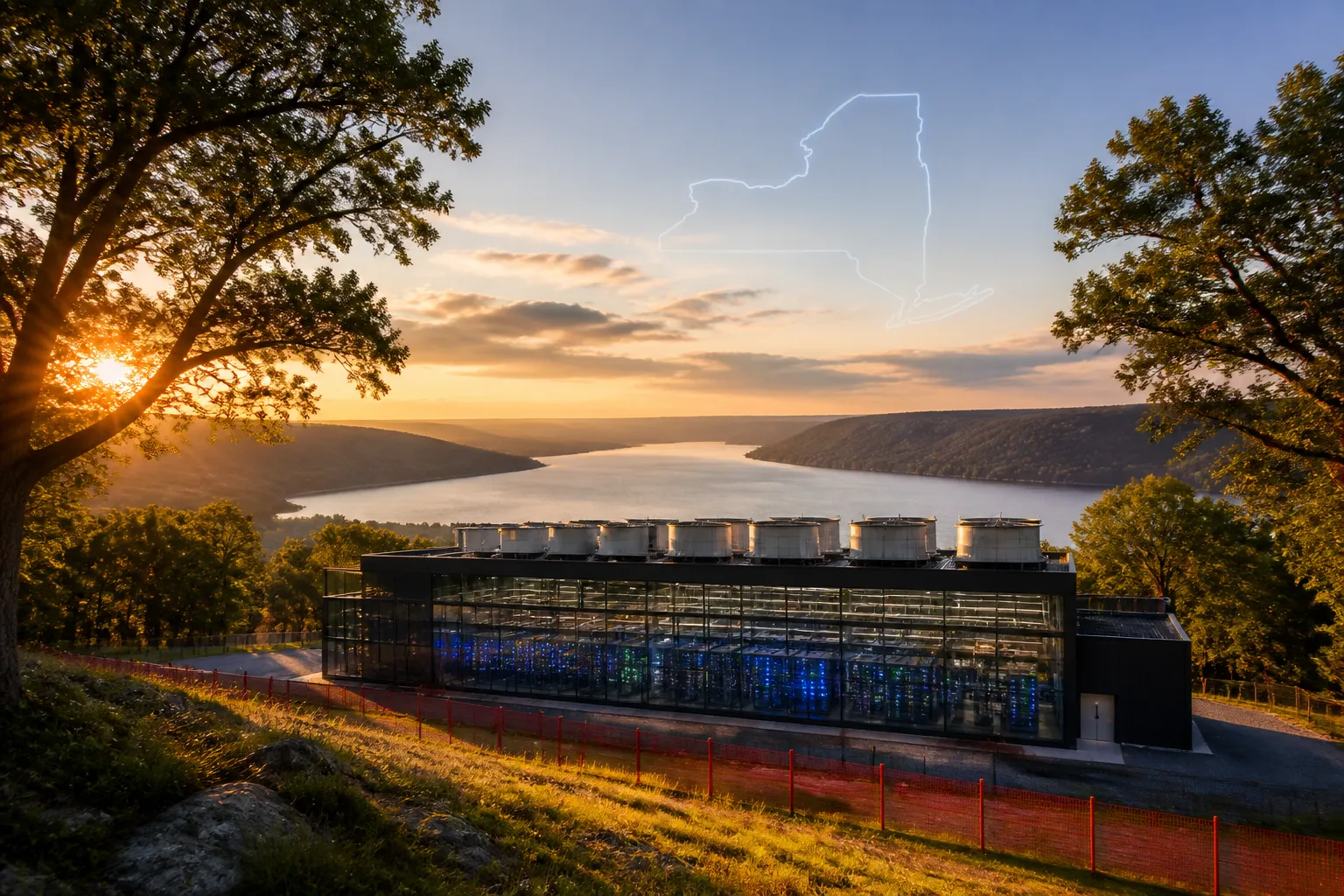
A bitcoin‑mining facility on the shore of Seneca Lake in the Finger Lakes region has announced a rebrand and a shift to data‑center operations, seeking an additional 200 megawatts (MW) of power from the state grid. The move comes as New York Governor Kathy Hochul’s executive order, signed on July 14, 2026, imposes a one‑year moratorium on new hyperscale data centers that use 50 MW or more.
The facility, formerly operated by Greenidge Generation Holdings, now trades under the name Vulcan Infrastructure and Power (ticker VIP). According to the company’s website, the plant currently delivers 107 MW of electricity, enough to power roughly 75,000 homes. Vulcan says it will keep the power‑plant operations unchanged and will continue to meet an emissions‑reduction agreement it has with the state.
Vulcan’s request for 200 MW would add enough capacity for about 150,000 homes, according to records from the New York State grid operator. The company says it has raised nearly $40 million in connection with the effort and has completed a $39.4 million private‑placement equity (PIPE) financing round, closing on July 19. It also says it plans to develop the site “immediately” as a data center.
The rebrand is part of a broader pivot toward artificial‑intelligence (AI) and high‑performance computing (HPC) workloads. Vulcan’s public filings describe a 654 MW pipeline of power assets that it intends to align with AI data‑center demand.
The governor’s moratorium applies to construction or expansion of data centers that use 50 MW or more. The Department of Environmental Conservation (DEC) has not confirmed whether Vulcan’s application falls under the moratorium. A DEC spokesperson, Jeff Wernick, said the department had not received any new applications relating to a change of use from crypto mining to data‑center operations.
Local residents and environmental groups have campaigned for the closure of the plant for roughly six years. They argue that the facility’s coal‑powered operations contribute to pollution that harms the Finger Lakes’ tourism industry and agricultural economy. “Greenidge can change its name, but it can’t change its track record,” said Yvonne Taylor, co‑founder of the Seneca Lake Guardian.
Lisa Perfetto, an attorney with the advocacy group Earth Justice, said the company’s shift is largely cosmetic. “It’s the same old company with a new name,” Perfetto said on social media. “They’re now just attempting to rebrand as an AI data center, but that just has the same potential to cause harm, to further increase harmful emissions.”
Vulcan’s statement notes that its power‑plant operations will not change and that it will continue to comply with the emissions‑reduction agreement. The company also says it believes it is well‑positioned to address the AI industry’s need for reliable, available power.
The facility’s revenue fell 25 % last year, to $15.2 million, according to the company’s financial reports. The decline follows a broader downturn in bitcoin mining profitability.
The situation illustrates the tension between the AI boom and state‑level climate and energy policies. New York’s moratorium is the first statewide pause on hyperscale data‑center development in the United States, and it is intended to allow the state to study the environmental impact of large data‑center projects.
As of July 30, 2026, the outcome of Vulcan’s request remains pending. The company’s application is under review by the DEC, and the state is still conducting its study on data‑center impacts. Local opposition continues to press for stricter enforcement of the moratorium and for the closure of the plant.
The broader industry watches the case closely, as it may set a precedent for how states balance AI infrastructure growth with environmental and energy‑grid constraints.
The facility, formerly operated by Greenidge Generation Holdings, now trades under the name Vulcan Infrastructure and Power (ticker VIP). According to the company’s website, the plant currently delivers 107 MW of electricity, enough to power roughly 75,000 homes. Vulcan says it will keep the power‑plant operations unchanged and will continue to meet an emissions‑reduction agreement it has with the state.
Vulcan’s request for 200 MW would add enough capacity for about 150,000 homes, according to records from the New York State grid operator. The company says it has raised nearly $40 million in connection with the effort and has completed a $39.4 million private‑placement equity (PIPE) financing round, closing on July 19. It also says it plans to develop the site “immediately” as a data center.
The rebrand is part of a broader pivot toward artificial‑intelligence (AI) and high‑performance computing (HPC) workloads. Vulcan’s public filings describe a 654 MW pipeline of power assets that it intends to align with AI data‑center demand.
The governor’s moratorium applies to construction or expansion of data centers that use 50 MW or more. The Department of Environmental Conservation (DEC) has not confirmed whether Vulcan’s application falls under the moratorium. A DEC spokesperson, Jeff Wernick, said the department had not received any new applications relating to a change of use from crypto mining to data‑center operations.
Local residents and environmental groups have campaigned for the closure of the plant for roughly six years. They argue that the facility’s coal‑powered operations contribute to pollution that harms the Finger Lakes’ tourism industry and agricultural economy. “Greenidge can change its name, but it can’t change its track record,” said Yvonne Taylor, co‑founder of the Seneca Lake Guardian.
Lisa Perfetto, an attorney with the advocacy group Earth Justice, said the company’s shift is largely cosmetic. “It’s the same old company with a new name,” Perfetto said on social media. “They’re now just attempting to rebrand as an AI data center, but that just has the same potential to cause harm, to further increase harmful emissions.”
Vulcan’s statement notes that its power‑plant operations will not change and that it will continue to comply with the emissions‑reduction agreement. The company also says it believes it is well‑positioned to address the AI industry’s need for reliable, available power.
The facility’s revenue fell 25 % last year, to $15.2 million, according to the company’s financial reports. The decline follows a broader downturn in bitcoin mining profitability.
The situation illustrates the tension between the AI boom and state‑level climate and energy policies. New York’s moratorium is the first statewide pause on hyperscale data‑center development in the United States, and it is intended to allow the state to study the environmental impact of large data‑center projects.
As of July 30, 2026, the outcome of Vulcan’s request remains pending. The company’s application is under review by the DEC, and the state is still conducting its study on data‑center impacts. Local opposition continues to press for stricter enforcement of the moratorium and for the closure of the plant.
The broader industry watches the case closely, as it may set a precedent for how states balance AI infrastructure growth with environmental and energy‑grid constraints.







