Blab Crypto
Coinbase Q2 2026 Earnings Miss Wall Street, Stock Falls to Two-Year Low
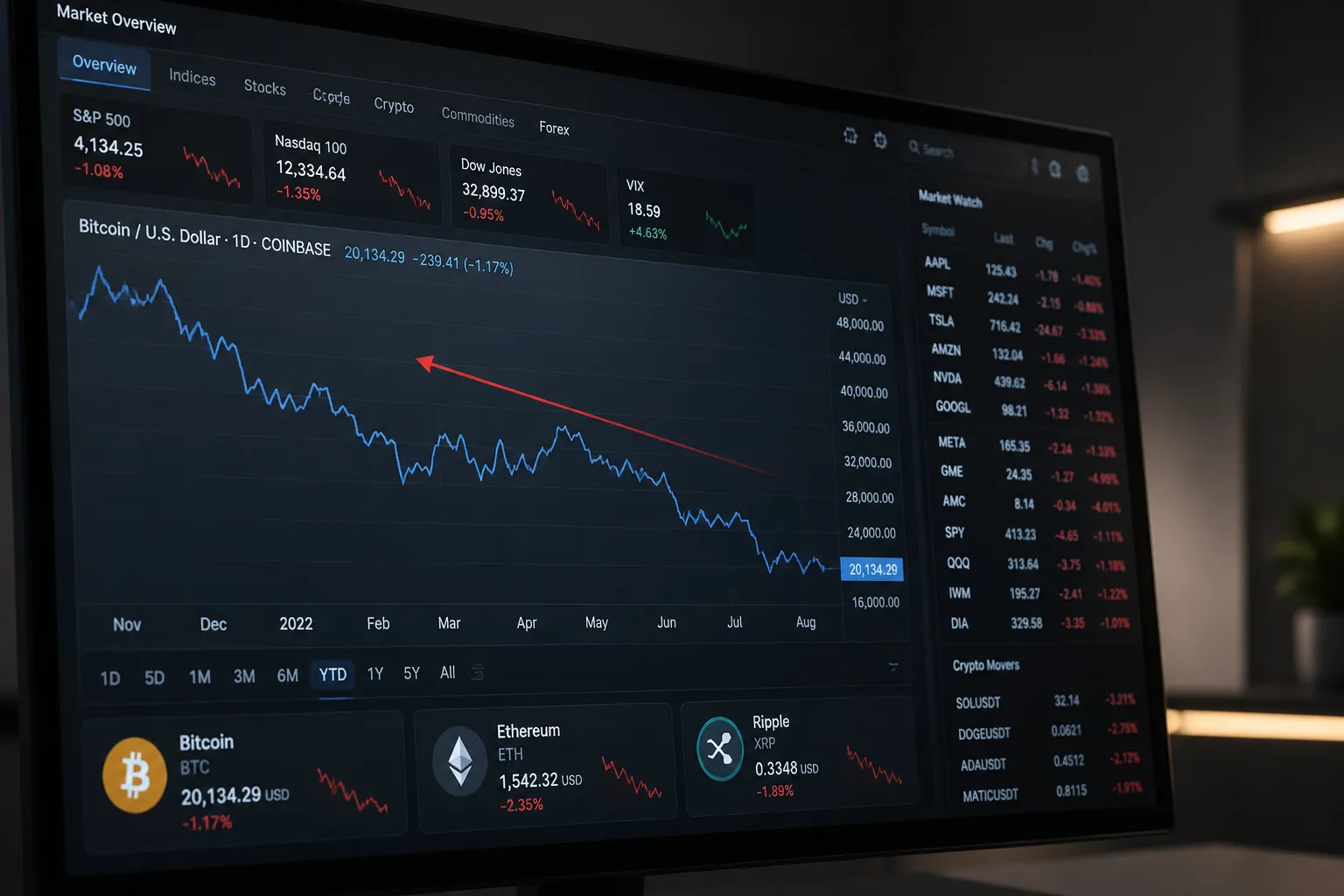
Coinbase Global, Inc. released its second‑quarter 2026 results on Monday, revealing revenue and earnings that fell short of analyst expectations and sending the company’s shares to a two‑and‑a‑half‑year low.
The exchange reported $1.22 billion in revenue and $208 million in adjusted EBITDA, both below consensus estimates. Net income turned into a $359.5 million loss, or $1.36 per share, according to a Yahoo Finance report. Lower crypto prices and muted trading volumes were cited as the main drivers of the decline.
Analysts largely blamed the broader crypto market environment rather than operational issues at Coinbase. JPMorgan said the results reflected a “tough crypto environment” and cut its December 2026 price target to $148 from $196 while maintaining an Overweight rating. Mizuho lowered its target to $155 from $200, describing Coinbase as a “good franchise” facing “tougher math.” Benchmark cut its target to $230 from $270.
Guidance for the third quarter also fell short of consensus, prompting several firms to trim their estimates. Cantor Fitzgerald called the quarter “another soft quarter” driven by depressed crypto prices. Oppenheimer said the miss stemmed from broader market weakness rather than operational problems.
Coinbase has been pursuing a strategy to become an “everything exchange,” expanding into stablecoins, payments, tokenized real‑world assets, prediction markets and derivatives. The company’s prediction‑market segment achieved a $100 million annualized revenue run rate, and its paid subscription tier, Coinbase One, surpassed one million subscribers. A partnership with Circle for the USDC stablecoin was renewed on existing terms, removing a key investor concern.
Despite these new revenue streams, analysts agreed they are not yet large or predictable enough to offset lost trading revenue. Clear Street noted the new businesses remain “optionality” rather than meaningful earnings contributors. Barclays was more critical, arguing that prediction markets and retail derivatives “did not” provide the boost they offered last quarter. Compass Point said emerging businesses “barely moved the needle.”
One positive metric was Coinbase’s record 10.3 % share of global crypto‑trading volume, its third consecutive quarterly gain. Analysts at Benchmark, Oppenheimer, Clear Street and Cantor highlighted the figure as evidence that trading activity is consolidating onto larger regulated exchanges during periods of stress. Coinbase also reported flat derivatives‑trading volumes even as management said the broader derivatives market declined by double digits.
Bernstein maintained an Outperform rating and a $330 price target, the highest among the analyst notes, but warned of competitive pressure. Robinhood has already pulled ahead in prediction markets through its integrated Rothera exchange, scaling that business to roughly $600 million annually compared to Coinbase’s $100 million.
The sharpest divide among analysts centers on expectations for the next few quarters. Barclays, which rates Coinbase Underweight, said July transaction revenue and third‑quarter guidance imply consensus estimates remain too high and expects earnings forecasts to fall unless trading activity rebounds. Compass Point warned that hopes surrounding a recovery may be premature.
On the other side, William Blair argued the post‑earnings sell‑off is a buying opportunity, saying Coinbase remains the largest beneficiary of any eventual crypto‑market recovery. Benchmark’s Mark Palmer wrote that the quarter provided “additional validation of the strategic transformation” underway at the company for the better part of three years.
Most bullish analysts maintained Buy or Outperform ratings despite cutting their price targets.
In summary, Coinbase’s Q2 2026 results underscored the continued softness in crypto trading volumes and prices. While the company’s diversification into subscription services, prediction markets and stablecoins shows promise, analysts remain cautious about the pace at which these new streams will grow. The stock’s current trajectory reflects a market that is still uncertain about a rebound in crypto activity.
The exchange reported $1.22 billion in revenue and $208 million in adjusted EBITDA, both below consensus estimates. Net income turned into a $359.5 million loss, or $1.36 per share, according to a Yahoo Finance report. Lower crypto prices and muted trading volumes were cited as the main drivers of the decline.
Analysts largely blamed the broader crypto market environment rather than operational issues at Coinbase. JPMorgan said the results reflected a “tough crypto environment” and cut its December 2026 price target to $148 from $196 while maintaining an Overweight rating. Mizuho lowered its target to $155 from $200, describing Coinbase as a “good franchise” facing “tougher math.” Benchmark cut its target to $230 from $270.
Guidance for the third quarter also fell short of consensus, prompting several firms to trim their estimates. Cantor Fitzgerald called the quarter “another soft quarter” driven by depressed crypto prices. Oppenheimer said the miss stemmed from broader market weakness rather than operational problems.
Coinbase has been pursuing a strategy to become an “everything exchange,” expanding into stablecoins, payments, tokenized real‑world assets, prediction markets and derivatives. The company’s prediction‑market segment achieved a $100 million annualized revenue run rate, and its paid subscription tier, Coinbase One, surpassed one million subscribers. A partnership with Circle for the USDC stablecoin was renewed on existing terms, removing a key investor concern.
Despite these new revenue streams, analysts agreed they are not yet large or predictable enough to offset lost trading revenue. Clear Street noted the new businesses remain “optionality” rather than meaningful earnings contributors. Barclays was more critical, arguing that prediction markets and retail derivatives “did not” provide the boost they offered last quarter. Compass Point said emerging businesses “barely moved the needle.”
One positive metric was Coinbase’s record 10.3 % share of global crypto‑trading volume, its third consecutive quarterly gain. Analysts at Benchmark, Oppenheimer, Clear Street and Cantor highlighted the figure as evidence that trading activity is consolidating onto larger regulated exchanges during periods of stress. Coinbase also reported flat derivatives‑trading volumes even as management said the broader derivatives market declined by double digits.
Bernstein maintained an Outperform rating and a $330 price target, the highest among the analyst notes, but warned of competitive pressure. Robinhood has already pulled ahead in prediction markets through its integrated Rothera exchange, scaling that business to roughly $600 million annually compared to Coinbase’s $100 million.
The sharpest divide among analysts centers on expectations for the next few quarters. Barclays, which rates Coinbase Underweight, said July transaction revenue and third‑quarter guidance imply consensus estimates remain too high and expects earnings forecasts to fall unless trading activity rebounds. Compass Point warned that hopes surrounding a recovery may be premature.
On the other side, William Blair argued the post‑earnings sell‑off is a buying opportunity, saying Coinbase remains the largest beneficiary of any eventual crypto‑market recovery. Benchmark’s Mark Palmer wrote that the quarter provided “additional validation of the strategic transformation” underway at the company for the better part of three years.
Most bullish analysts maintained Buy or Outperform ratings despite cutting their price targets.
In summary, Coinbase’s Q2 2026 results underscored the continued softness in crypto trading volumes and prices. While the company’s diversification into subscription services, prediction markets and stablecoins shows promise, analysts remain cautious about the pace at which these new streams will grow. The stock’s current trajectory reflects a market that is still uncertain about a rebound in crypto activity.







