Blab Crypto
Bitcoin Enters BIP-110 Mandatory Signaling With Minimal Miner Support, Leading to a Minor Chain Split
On a quiet Saturday, August 8, 2026, Bitcoin entered the mandatory‑signaling phase of BIP‑110 at block 961,632. According to the BIP‑110 monitor, only 51 of the preceding 2,016 blocks set the required version‑bit 4 flag, yielding a miner‑support rate of just 2.53 %. The signaling window extends from block 961,632 to 963,647, with the lock‑in at 963,648 and activation slated for 965,664.
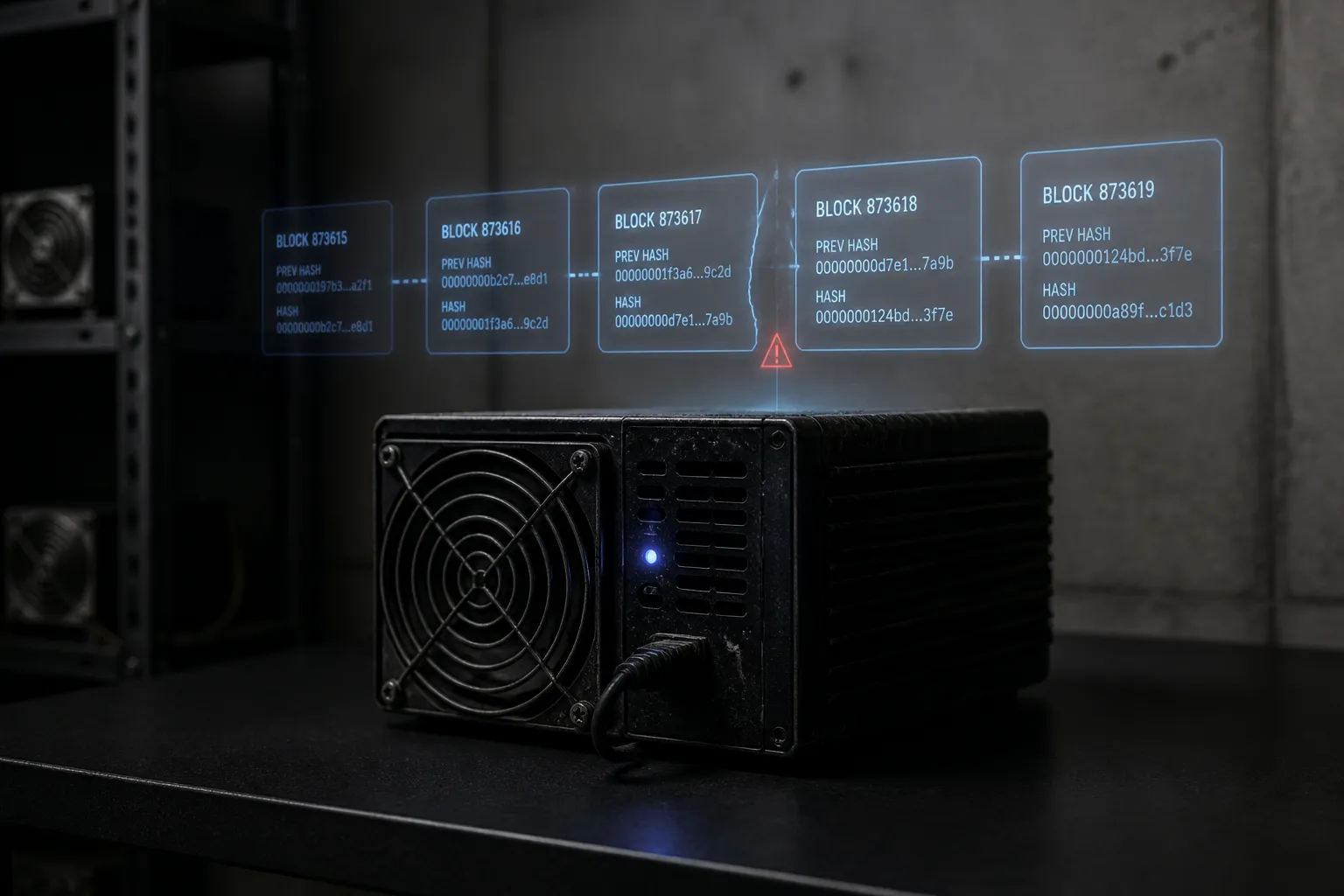
BIP‑110 proposes a temporary soft‑fork that caps transaction script sizes to curb spam. Nodes that have switched to enforcement reject any block lacking the version‑bit 4 flag, while standard nodes remain permissive. When enforcement kicked in, the minority branch that rejected non‑signaling blocks fell behind almost immediately. It stopped at block 961,633, whereas the dominant chain advanced to block 961,744. The monitor also shows that none of the first 113 blocks on the main chain carried the signaling flag after the window opened.
The split underscores Bitcoin’s resilience when miner support is thin. Roughnecks, a pool that had earlier signaled for BIP‑110, announced it would shut down after a meeting at 0340 UTC. Michael Saylor, executive chairman of Strategy, noted that “about 99.85 % of Bitcoin’s hashpower stayed with Bitcoin,” framing the outcome as a decisive test of miner alignment.
Technically, BIP‑110 limits most new output scripts to 34 bytes and caps OP_RETURN outputs at 83 bytes; UTXOs created before activation are exempt. The proposal’s activation window lasts roughly a year, during which these limits would be enforced. Because the enforcing branch inherited the same mining target as the main chain, losing the majority of hashpower does not make blocks easier to find. Analysts estimate that the minority branch would need about 25 years to reach its first difficulty adjustment.
Monitoring continues to show that miner support remains far below the 55 % threshold required for a hard‑fork fallback. The BIP‑110 monitor and other independent dashboards confirm that the enforcement branch has stalled, while the main chain continues under existing consensus rules. The network’s ability to keep a single longest chain despite the split demonstrates the robustness of Bitcoin’s proof‑of‑work consensus.
When the mandatory‑signaling window closes, the network will either lock in BIP‑110 if the required support is reached by block 963,648 or revert to the status quo if it is not. Activation at block 965,664 would then impose the temporary transaction restrictions. Until that moment, the Bitcoin network remains in a low‑support soft‑fork testing phase, with the majority of miners and nodes operating under the current protocol.
In short, BIP‑110 entered its mandatory‑signaling phase with only 2.53 % miner support, triggering a brief chain split that quickly stalled. The enforcement branch remains behind the main chain, and the outcome of the signaling window will decide whether the temporary restrictions are adopted.
BIP‑110 proposes a temporary soft‑fork that caps transaction script sizes to curb spam. Nodes that have switched to enforcement reject any block lacking the version‑bit 4 flag, while standard nodes remain permissive. When enforcement kicked in, the minority branch that rejected non‑signaling blocks fell behind almost immediately. It stopped at block 961,633, whereas the dominant chain advanced to block 961,744. The monitor also shows that none of the first 113 blocks on the main chain carried the signaling flag after the window opened.
The split underscores Bitcoin’s resilience when miner support is thin. Roughnecks, a pool that had earlier signaled for BIP‑110, announced it would shut down after a meeting at 0340 UTC. Michael Saylor, executive chairman of Strategy, noted that “about 99.85 % of Bitcoin’s hashpower stayed with Bitcoin,” framing the outcome as a decisive test of miner alignment.
Technically, BIP‑110 limits most new output scripts to 34 bytes and caps OP_RETURN outputs at 83 bytes; UTXOs created before activation are exempt. The proposal’s activation window lasts roughly a year, during which these limits would be enforced. Because the enforcing branch inherited the same mining target as the main chain, losing the majority of hashpower does not make blocks easier to find. Analysts estimate that the minority branch would need about 25 years to reach its first difficulty adjustment.
Monitoring continues to show that miner support remains far below the 55 % threshold required for a hard‑fork fallback. The BIP‑110 monitor and other independent dashboards confirm that the enforcement branch has stalled, while the main chain continues under existing consensus rules. The network’s ability to keep a single longest chain despite the split demonstrates the robustness of Bitcoin’s proof‑of‑work consensus.
When the mandatory‑signaling window closes, the network will either lock in BIP‑110 if the required support is reached by block 963,648 or revert to the status quo if it is not. Activation at block 965,664 would then impose the temporary transaction restrictions. Until that moment, the Bitcoin network remains in a low‑support soft‑fork testing phase, with the majority of miners and nodes operating under the current protocol.
In short, BIP‑110 entered its mandatory‑signaling phase with only 2.53 % miner support, triggering a brief chain split that quickly stalled. The enforcement branch remains behind the main chain, and the outcome of the signaling window will decide whether the temporary restrictions are adopted.







