Blab Crypto
Major Crypto Trading Pairs Define Market Liquidity and Investor Exposure
In the frenetic world of crypto trading, the right pair can make all the difference. A new analysis cuts through the noise, showing how Bitcoin, Ethereum, and Solana pair with stablecoins and each other to give traders clear exposure, deep liquidity, and a practical way to manage risk.
Bitcoin remains the heavyweight champ, boasting a market capitalization of roughly $1.3 trillion. Ethereum follows as the second‑largest asset at about $227 billion. Together, they anchor market sentiment and serve as the yardsticks against which other tokens are measured.
The most common Bitcoin pairings are BTC/USDT and BTC/USDC. Both translate Bitcoin’s value into a dollar‑linked stablecoin, making profit or loss calculations straightforward. BTC/USDT is typically more widely available across exchanges, while BTC/USDC feels more natural for users already holding USDC or trading on platforms that favor that stablecoin. The choice usually comes down to which pair offers deeper liquidity and lower transaction costs on a given venue.
Ethereum mirrors Bitcoin’s structure with ETH/USDT and ETH/USDC. These pairs provide a simple way to view Ethereum’s value in dollar terms. The decision between USDT and USDC for Ethereum exposure is largely practical; some exchanges have better USDT liquidity, while others are built around USDC. The article also highlights the ETH/BTC pair, which reflects Ethereum’s relative strength against Bitcoin. When ETH/BTC rises, Ethereum gains strength relative to Bitcoin, and vice versa. The pair can be confusing because it may rise even when both assets fall in dollar terms, as it only shows their relative performance.
Solana’s pairings—SOL/USDT and SOL/USDC—introduce more volatility. Solana can swing quickly in either direction, especially when interest in decentralized exchanges or Solana‑based applications spikes. SOL/USDC is common inside the Solana ecosystem, while SOL/USDT may have stronger liquidity on certain centralized exchanges. The article notes that Solana’s size draws serious market attention, but its price can still react sharply to changing sentiment.
The USDC/USDT pair stands apart from the others because it is not an investment idea but a practical tool for moving funds between stablecoins. Both stablecoins aim to stay near one US dollar, so the pair trades within a narrow range. It is useful when one stablecoin offers better liquidity, wider support, or easier access to a particular market. The article cautions that stablecoins carry issuer, reserve, and transparency risks, and either coin can briefly lose its peg during stressful market conditions.
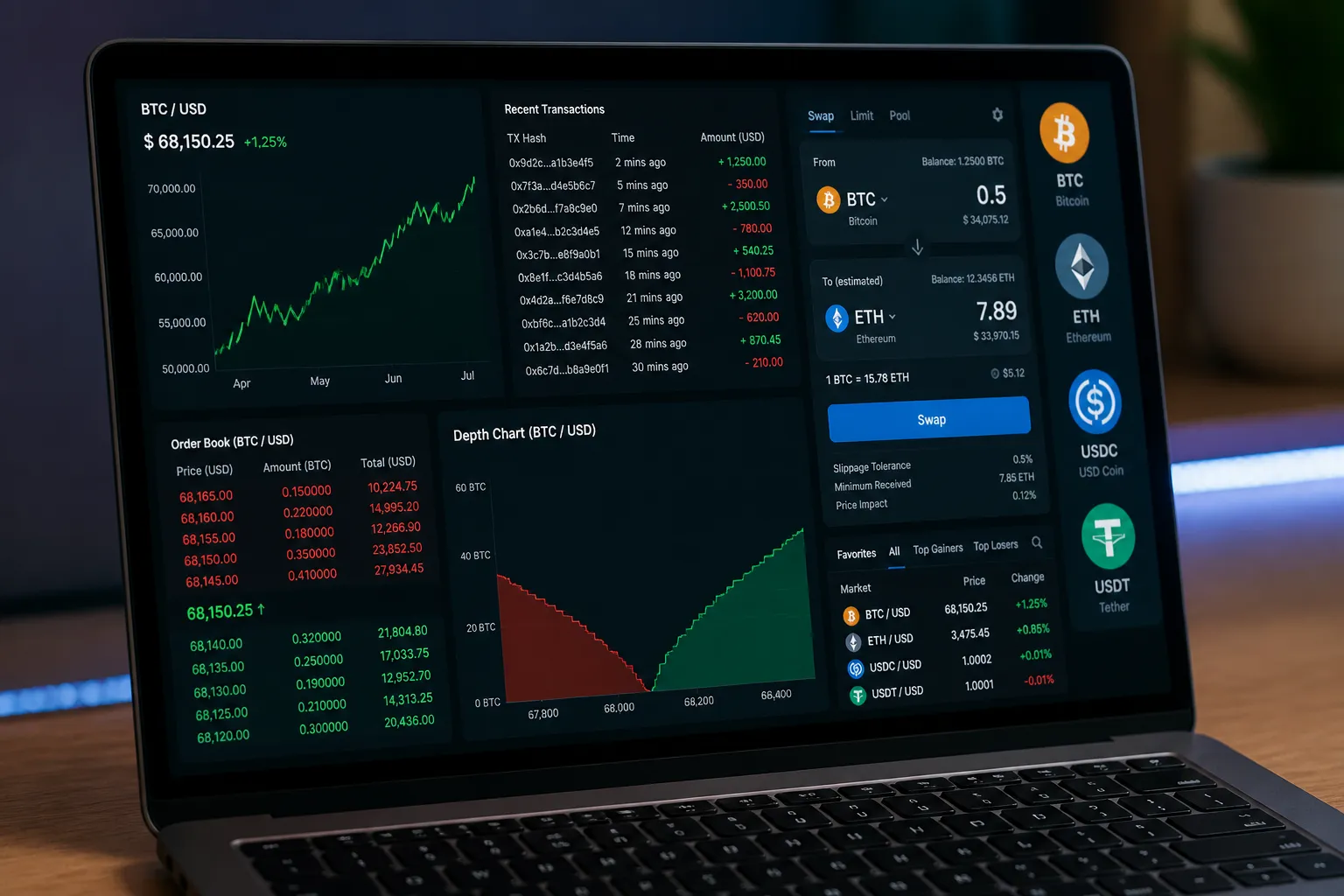
When swapping crypto, the article emphasizes that most headaches stem from liquidity, slippage, and fees rather than from choosing between BTC and ETH. Traders focus on liquidity and available trading volume, the difference between the displayed price and the final output, network and platform fees, the correct token and blockchain network, and stablecoin, smart‑contract, and platform risk. Price impact and slippage are grouped together, even though they describe different things: price impact is the effect a trade has on the market or liquidity pool, while slippage is the difference between the expected price and the completed price.
In a bull market, Bitcoin pairs can seem sluggish when smaller coins surge 20 % or 30 % in a single day. That can be frustrating, but the slower pace is also part of the appeal. BTC tends to give a clearer view of the overall market than a token driven by one exchange listing or a social media trend.
The analysis concludes that understanding a small set of liquid pairs—BTC/USDT, BTC/USDC, ETH/USDT, ETH/USDC, ETH/BTC, SOL/USDT, SOL/USDC, and USDC/USDT—is more useful than chasing dozens of tokens with no clear purpose. These pairs remain valuable long after the hype fades, providing a stable foundation for traders and investors to gauge market direction, manage risk, and execute swaps efficiently.
Bitcoin remains the heavyweight champ, boasting a market capitalization of roughly $1.3 trillion. Ethereum follows as the second‑largest asset at about $227 billion. Together, they anchor market sentiment and serve as the yardsticks against which other tokens are measured.
The most common Bitcoin pairings are BTC/USDT and BTC/USDC. Both translate Bitcoin’s value into a dollar‑linked stablecoin, making profit or loss calculations straightforward. BTC/USDT is typically more widely available across exchanges, while BTC/USDC feels more natural for users already holding USDC or trading on platforms that favor that stablecoin. The choice usually comes down to which pair offers deeper liquidity and lower transaction costs on a given venue.
Ethereum mirrors Bitcoin’s structure with ETH/USDT and ETH/USDC. These pairs provide a simple way to view Ethereum’s value in dollar terms. The decision between USDT and USDC for Ethereum exposure is largely practical; some exchanges have better USDT liquidity, while others are built around USDC. The article also highlights the ETH/BTC pair, which reflects Ethereum’s relative strength against Bitcoin. When ETH/BTC rises, Ethereum gains strength relative to Bitcoin, and vice versa. The pair can be confusing because it may rise even when both assets fall in dollar terms, as it only shows their relative performance.
Solana’s pairings—SOL/USDT and SOL/USDC—introduce more volatility. Solana can swing quickly in either direction, especially when interest in decentralized exchanges or Solana‑based applications spikes. SOL/USDC is common inside the Solana ecosystem, while SOL/USDT may have stronger liquidity on certain centralized exchanges. The article notes that Solana’s size draws serious market attention, but its price can still react sharply to changing sentiment.
The USDC/USDT pair stands apart from the others because it is not an investment idea but a practical tool for moving funds between stablecoins. Both stablecoins aim to stay near one US dollar, so the pair trades within a narrow range. It is useful when one stablecoin offers better liquidity, wider support, or easier access to a particular market. The article cautions that stablecoins carry issuer, reserve, and transparency risks, and either coin can briefly lose its peg during stressful market conditions.
When swapping crypto, the article emphasizes that most headaches stem from liquidity, slippage, and fees rather than from choosing between BTC and ETH. Traders focus on liquidity and available trading volume, the difference between the displayed price and the final output, network and platform fees, the correct token and blockchain network, and stablecoin, smart‑contract, and platform risk. Price impact and slippage are grouped together, even though they describe different things: price impact is the effect a trade has on the market or liquidity pool, while slippage is the difference between the expected price and the completed price.
In a bull market, Bitcoin pairs can seem sluggish when smaller coins surge 20 % or 30 % in a single day. That can be frustrating, but the slower pace is also part of the appeal. BTC tends to give a clearer view of the overall market than a token driven by one exchange listing or a social media trend.
The analysis concludes that understanding a small set of liquid pairs—BTC/USDT, BTC/USDC, ETH/USDT, ETH/USDC, ETH/BTC, SOL/USDT, SOL/USDC, and USDC/USDT—is more useful than chasing dozens of tokens with no clear purpose. These pairs remain valuable long after the hype fades, providing a stable foundation for traders and investors to gauge market direction, manage risk, and execute swaps efficiently.