Blab Crypto
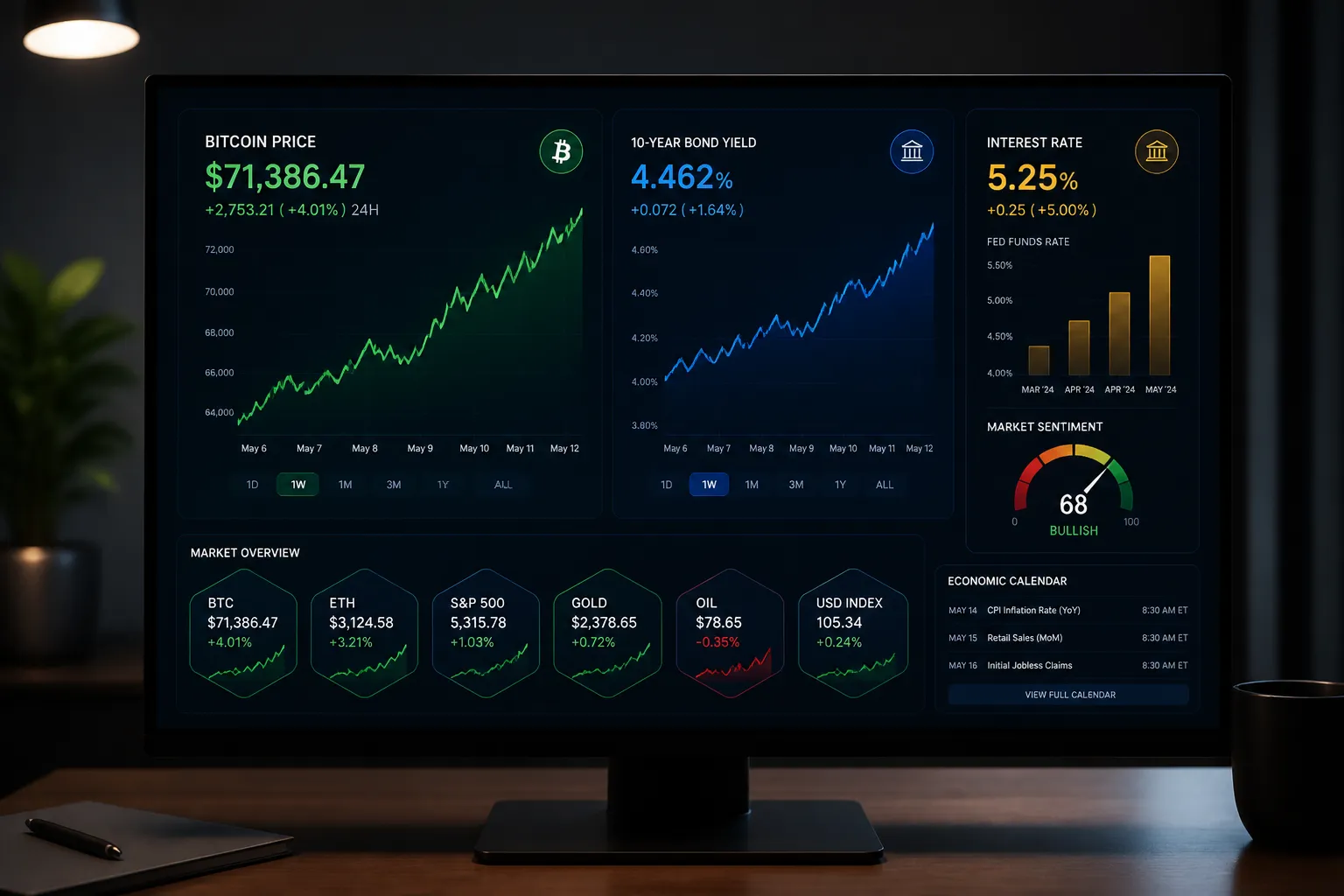
Bitcoin Holds Near $77,000 as Bond Yields Rise and Fed Rate Hike Odds Surge
Bitcoin traded around $76,500 on Wednesday, after a sharp sell‑off in global bond markets that has tested the cryptocurrency’s August rally.
Japan’s 10‑year government bond yield has climbed above 3% for a second straight day, the highest level in 30 years. U.S. and European yields are also on the rise, with the U.S. 10‑year Treasury yield hitting its tallest point since January 2025 and German 10‑year bunds reaching a 15‑year high.
Higher yields strengthen the U.S. dollar and raise the opportunity cost of holding non‑yielding assets such as Bitcoin and gold. At the same time, Brent crude has surged past $95 a barrel amid renewed U.S.–Iran tensions, adding to worries about energy supply disruptions.
Market pricing now reflects a 66 % probability of a September Fed rate hike, up from 35 % last week. The jump follows a hawkish stance by Fed Governor Kevin Warsh at the Jackson Hole symposium on Friday. Historically, Bitcoin performs better in lower‑interest‑rate environments because liquidity is higher.
Gold dipped to a three‑week low, but Bitcoin’s pullback from its August high of $81.5 k has been modest. The cryptocurrency’s relative resilience against the challenging macro backdrop is notable. The retreat suggests a consolidation phase after August’s 25 % surge, allowing the market to work off overbought conditions.
The next major catalyst is the U.S. non‑farm payroll (NFP) report due Friday, followed by a CPI inflation release next week before the September 16 Fed rate decision. The Fed’s policy is increasingly data‑dependent, so the market could react sharply to any significant upside or downside surprise.
August was a strong month for exchange‑traded product (ETP) demand. Global Bitcoin ETPs recorded inflows of 52,152 BTC, the largest since November 2024. The Strategy fund also bought again for the first time since June, accumulating 4,603 BTC for $369.7 million last week. This marks a sharp reversal from previous months of equity selling, including record ETF outflows in May and June. Persistent institutional demand could help Bitcoin recover higher.
September has historically been a difficult month for Bitcoin, with CoinGlass data showing an average return of around –2.9 %. However, the recent performance is more encouraging, with Bitcoin finishing higher in each of the past three Septembers.
From a technical perspective, Bitcoin broke above the 50‑period exponential moving average (EMA) and rose to $81.5 k before easing back and consolidating around $77 k. The pullback has taken the relative strength index (RSI) out of overbought territory, providing some room for further upside.
Key support levels sit at $77 k, the 78.6 % Fibonacci retracement of the $57.7 k–$82.9 k move. Below that, attention turns to $73.4 k, the 61.8 % Fibonacci retracement, and the 200‑period EMA at $72.4 k. A break below $67 k would negate the near‑term bullish trend.
Buyers will look to break above $80 k to extend gains toward the May high of $82.9 k. A move above that level would bring $90 k into focus, followed by $95 k.
In summary, Bitcoin is holding near $77 k amid rising bond yields and heightened expectations of a September Fed rate hike. Institutional inflows into Bitcoin ETPs have rebounded, and the cryptocurrency remains relatively resilient compared with gold. The market is now awaiting the U.S. NFP report and upcoming CPI data, which could influence the Fed’s policy decision and, in turn, Bitcoin’s short‑term trajectory. The next key technical levels are $80 k for a potential rally and $73.4 k for a possible retracement.
Japan’s 10‑year government bond yield has climbed above 3% for a second straight day, the highest level in 30 years. U.S. and European yields are also on the rise, with the U.S. 10‑year Treasury yield hitting its tallest point since January 2025 and German 10‑year bunds reaching a 15‑year high.
Higher yields strengthen the U.S. dollar and raise the opportunity cost of holding non‑yielding assets such as Bitcoin and gold. At the same time, Brent crude has surged past $95 a barrel amid renewed U.S.–Iran tensions, adding to worries about energy supply disruptions.
Market pricing now reflects a 66 % probability of a September Fed rate hike, up from 35 % last week. The jump follows a hawkish stance by Fed Governor Kevin Warsh at the Jackson Hole symposium on Friday. Historically, Bitcoin performs better in lower‑interest‑rate environments because liquidity is higher.
Gold dipped to a three‑week low, but Bitcoin’s pullback from its August high of $81.5 k has been modest. The cryptocurrency’s relative resilience against the challenging macro backdrop is notable. The retreat suggests a consolidation phase after August’s 25 % surge, allowing the market to work off overbought conditions.
The next major catalyst is the U.S. non‑farm payroll (NFP) report due Friday, followed by a CPI inflation release next week before the September 16 Fed rate decision. The Fed’s policy is increasingly data‑dependent, so the market could react sharply to any significant upside or downside surprise.
August was a strong month for exchange‑traded product (ETP) demand. Global Bitcoin ETPs recorded inflows of 52,152 BTC, the largest since November 2024. The Strategy fund also bought again for the first time since June, accumulating 4,603 BTC for $369.7 million last week. This marks a sharp reversal from previous months of equity selling, including record ETF outflows in May and June. Persistent institutional demand could help Bitcoin recover higher.
September has historically been a difficult month for Bitcoin, with CoinGlass data showing an average return of around –2.9 %. However, the recent performance is more encouraging, with Bitcoin finishing higher in each of the past three Septembers.
From a technical perspective, Bitcoin broke above the 50‑period exponential moving average (EMA) and rose to $81.5 k before easing back and consolidating around $77 k. The pullback has taken the relative strength index (RSI) out of overbought territory, providing some room for further upside.
Key support levels sit at $77 k, the 78.6 % Fibonacci retracement of the $57.7 k–$82.9 k move. Below that, attention turns to $73.4 k, the 61.8 % Fibonacci retracement, and the 200‑period EMA at $72.4 k. A break below $67 k would negate the near‑term bullish trend.
Buyers will look to break above $80 k to extend gains toward the May high of $82.9 k. A move above that level would bring $90 k into focus, followed by $95 k.
In summary, Bitcoin is holding near $77 k amid rising bond yields and heightened expectations of a September Fed rate hike. Institutional inflows into Bitcoin ETPs have rebounded, and the cryptocurrency remains relatively resilient compared with gold. The market is now awaiting the U.S. NFP report and upcoming CPI data, which could influence the Fed’s policy decision and, in turn, Bitcoin’s short‑term trajectory. The next key technical levels are $80 k for a potential rally and $73.4 k for a possible retracement.







